Audit Passed ≠ Safe: Lessons from DeFi Crashes in H1 2026
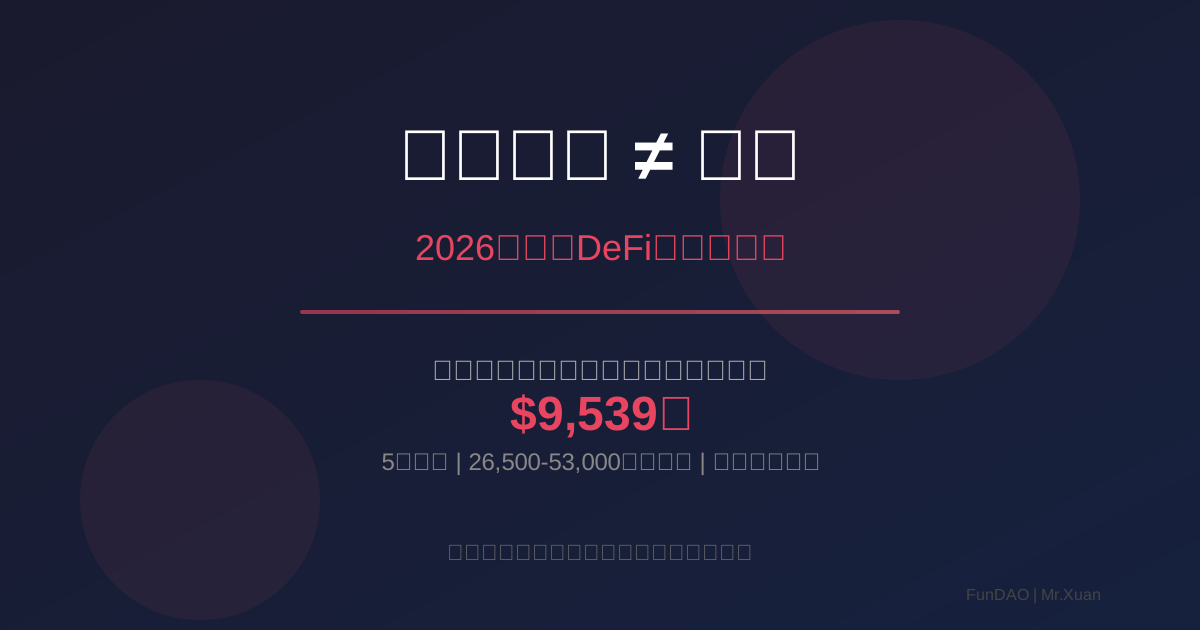
Audit Passed ≠ Safe: DeFi Crash Lessons from H1 2026
In the first half of 2026, the crypto industry experienced multiple major security incidents. Shockingly, rekt.news statistics show that all major loss projects passed security audits. This means: passing an audit does not equal fund safety.
This article analyzes audit limitations through real cases and explores what mechanism design can truly protect investors.
1. Major Security Incidents in H1 2026
1.1 AFX Trade: $24.15M Drained
- Event: 5 validator signatures compromised, attacker drained all USDC from Arbitrum bridge contract
- Audit Status: Passed
- Loss: $24.15M, zeroed out
- Affected Users: ~3,000-6,000
1.2 Ostium: Oracle Manipulation Drains $23.75M
- Event: Attacker forged $60,000 BTC price quote, drained treasury through fake trades
- Audit Status: Passed
- Loss: $23.75M, zeroed out
- Affected Users: ~2,000-4,000 traders
1.3 BonkDAO: Governance Attack Steals $19.3M
- Event: Attacker bought 1% BONK, embedded treasury transfer in boring proposal, passed with only 2.9% voting rate
- Audit Status: Passed
- Loss: $19.3M, zeroed out
- Affected Users: ~15,000-30,000 BONK holders
2. Why Audits Can't Guarantee Safety?
2.1 Audits Check Code, Not "People"
Security audits mainly check smart contract code for vulnerabilities. But 2026 cases show that the attack surface is in "people," not code:
- AFX Trade: Validator signatures compromised (people problem)
- BonkDAO: Governance voting manipulated (people problem)
- Ostium: Oracle feed manipulated (data source problem)
2.2 Audits Are Static, Attacks Are Dynamic
Audits happen at a point in time, but attackers continuously seek new vectors. Code safe today doesn't mean safe tomorrow.
2.3 Audit Firms Have Conflicts of Interest
Audit firms are paid by projects, creating "bite the hand that feeds" issues. Some may not flag all problems to maintain client relationships.
3. FunDAO's Six-Zero Architecture: Solving Security from the Root
FunDAO doesn't rely on audits for security, but eliminates risk through mechanism design:
| Risk Type | Traditional DeFi | FunDAO |
|---|---|---|
| Team rug pull | Relies on audit + trust | No project team, permissions discarded |
| Backdoor/minting | Audit may miss | No backdoor, contract immutable |
| Governance attack | Voting can be manipulated | No voting needed, rules fixed |
| Oracle manipulation | Depends on external data | Doesn't rely on external oracles |
| Validator compromise | Multi-sig can be breached | No multi-sig, on-chain auto-execution |
| Fund misappropriation | Team can move funds | Funds locked in contract, untouchable |
4. Key Conclusion
Audits are necessary but not sufficient. True security comes from mechanism design, not code review.
FunDAO's Six-Zero architecture (no project team, no private sale, no reserve, no hidden wallets, no backdoor, permissions discarded) eliminates traditional DeFi security risks from the root. Even without an audit, FunDAO's mechanism ensures fund safety — because no one can do evil.
When choosing DeFi projects, investors should not only look at "whether it passed audit," but also whether the mechanism design fundamentally eliminates risks.