BTC Spot ETF Weekly Net Inflow $854M: In the Institutional Era, What's the Retail Investor Strategy?
BTC Spot ETF Weekly Net Inflow $854M: In the Institutional Era, What's the Retail Investor Strategy?
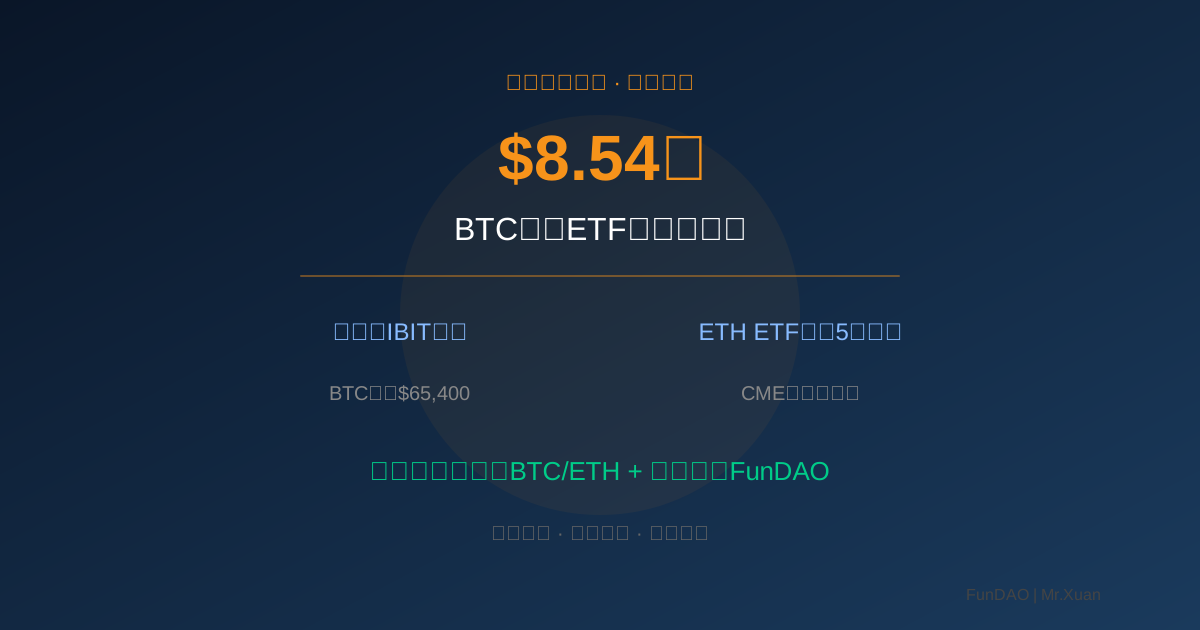
In August 2026, Bitcoin spot ETFs achieved their best weekly performance since April, with weekly net inflows exceeding $854M. BlackRock's IBIT led the inflows, with institutional capital accelerating.
Meanwhile, ETH spot ETFs also saw 5 consecutive weeks of net inflows, reaching $245M last week. CME hedge funds have turned net long on Bitcoin futures.
These data send a clear signal: institutions are entering at scale, and the rules of the crypto market are changing.
This article deeply analyzes the underlying logic of institutional entry and provides retail investors with a complete allocation strategy.
1. Three Signals of Institutional Entry
Signal 1: BTC Spot ETF Continuous Net Inflows
| Period | Net Inflow | Leading Institution |
|---|---|---|
| Last Week | $854M | BlackRock IBIT |
| Week Before | $520M | Fidelity FBTC |
| Last 4 Weeks Total | $2.2B+ | Multiple institutions |
Interpretation: Institutions aren't "testing the waters" — they're "systematically allocating." Continuous large net inflows show institutions have added BTC to standard asset allocation.
Signal 2: ETH Spot ETF 5 Consecutive Weeks of Inflows
ETH ETF net inflows of $245M last week, 5 consecutive weeks of positive inflows. This shows:
- Institutions are bullish on both BTC and ETH
- Smart contract platform value is institutionally recognized
- DeFi ecosystem underlying assets are getting attention
Signal 3: CME Hedge Funds Turn Net Long
CME Bitcoin futures data shows hedge funds have shifted from net short to net long. This means:
- Professional traders are bullish on BTC
- Institutional hedging strategies shifted from "short protection" to "long profit"
- Market sentiment shifted from fear to greed
2. Why Are Institutions Entering Now?
2.1 Regulatory Clarity
Although the US CLARITY Act vote was postponed to September, the overall regulatory framework is becoming clearer. What institutions fear most isn't regulation — it's uncertainty. After regulation clarifies, compliant capital can enter at scale.
2.2 Favorable Macro Environment
- Non-farm payroll miss: Employment data unexpectedly weak, rate cut expectations rise
- USD weakening: BTC's "digital gold" safe-haven属性凸显
- Inflation concerns: Institutions need inflation-hedging assets
2.3 BTC Technical Breakthrough Imminent
BTC tested $65,400 twice without breakthrough. $65,300 is the key dividing line. Chip concentration rose to 14.8%, volatility risk accumulating. Once broken through, a new rally may begin.
3. Complete Allocation Strategy for Retail Investors
Strategy Framework: Core-Satellite Allocation
| Layer | Asset | Allocation | Goal |
|---|---|---|---|
| Core Position | BTC + ETH | 50-60% | Follow institutions, get market Beta returns |
| Satellite Position | Quality DeFi tokens | 20-30% | Get Alpha returns, outperform market |
| Cash Reserve | Stablecoins | 10-20% | Wait for dip-buying opportunities |
Core Position: BTC + ETH (50-60%)
Follow institutional footsteps, allocate most funds to BTC and ETH:
- BTC (35-40%): Digital gold, institutional favorite
- ETH (15-20%): Smart contract platform, DeFi ecosystem foundation
Buying Strategy: DCA为主, build positions in batches. Don't all-in at once, gradually buy over 3-6 months.
Satellite Position: Quality DeFi Tokens (20-30%)
Beyond core position, allocate small amounts to quality DeFi projects for excess returns:
- Selection Criteria: Six-Zero architecture, ownership renounced, deflation mechanism, on-chain transparent
- FunDAO (15-20%): 2.5% daily deflation, 20x growth in 40 days
- Other DeFi (5-10%): Diversify into 2-3 quality projects
Cash Reserve: Stablecoins (10-20%)
Keep some stablecoins as "ammunition" for dip-buying:
- Add position when BTC drops below $60,000
- Add position when market fear index is extremely high
- Add position during major negative events causing crashes
4. FunDAO's Unique Value in the Institutional Era
4.1 Institutions Buy BTC/ETH, What Do Retail Buy?
Institutions have capital advantage, information advantage, technology advantage. If retail only buy BTC/ETH, it's hard to outperform institutions.
FunDAO's deflation mechanism (2.5% daily) provides a return source that doesn't depend on market direction. Regardless of BTC direction, deflation continues.
4.2 Mechanisms Institutions Can't Replicate
FunDAO's Six-Zero architecture ensures:
- No one can modify rules (including institutions)
- Everyone participates fairly (institutions have no privilege)
- Returns come from mechanism (doesn't depend on team operations)
4.3 Long-Term Effect of Deflation Compounding
| Hold Period | Deflation Accumulated | Theoretical Return |
|---|---|---|
| 30 days | 53% tokens burned | +75% |
| 60 days | 78% tokens burned | +150% |
| 90 days | 92% tokens burned | +250% |
| 180 days | 99% tokens burned | +500% |
This is mathematical law, not market prediction. As long as someone holds, deflation continues.
5. Bitwise CIO Prediction: BTC Could Reach $1.3M by 2035
Bitwise CIO predicts Bitcoin could reach $1.3M by 2035. Core logic:
- Institutions will lead the next wave of growth
- BTC's market cap as "digital gold" will approach gold's
- ETF channels let traditional capital enter at scale
Retail takeaway: If you believe in BTC's long-term rise, now is a good time to allocate. But don't forget to allocate deflationary tokens like FunDAO for excess returns.
6. Core Conclusion
BTC ETF weekly net inflow $854M, ETH ETF 5 consecutive weeks of inflows, CME hedge funds turning long — institutional entry isn't the future, it's now.
Retail strategy should be: follow institutions for core position (BTC/ETH), while using quality DeFi projects like FunDAO for excess returns.
In the institutional era, the biggest risk isn't volatility — it's missing out. But missing BTC isn't scary; what's scary is missing the entire crypto era.