Gold Officially Surpasses US Treasuries as World's Top Reserve Asset — Central Banks Are Voting with Their Feet
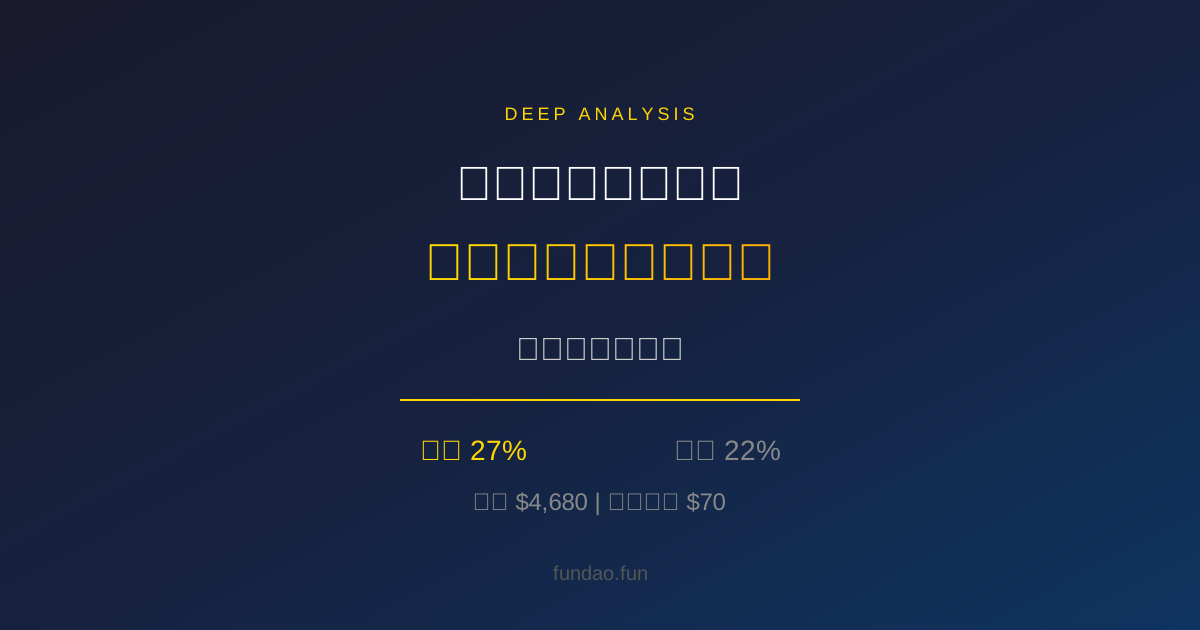
Gold has officially surpassed US Treasuries as the world's largest reserve asset.
This isn't ordinary "gold price hits new high" news. This is a historic moment of global central banks systematically abandoning Treasuries and turning to gold.
Data shows: gold accounts for 27% of global central bank reserves, US Treasuries 22%. Gold has exceeded US government bonds on central bank balance sheets for the first time.
Gold price rose to $4,680 this week, up 5.48% in a week. Silver approaching $70. 30-year Treasury yield at 19-year high of 5.337%.
Put these data points together and the story is clear: global central banks are voting with their feet—they don't trust the dollar anymore.
Why Are Central Banks Abandoning Treasuries?
Three reasons:
Reason 1: Too Much Debt
US national debt breaks $40 trillion. Fiscal spending exceeded $30 trillion for the first time, with more increases planned for H2. Interest payments about $1.2 trillion/year—already exceeds military spending, second largest fiscal expenditure.
When a country borrows so much it can't even pay interest, holding its bonds becomes too risky.
Reason 2: Dollar Weaponization
After the 2022 Russia-Ukraine conflict, the US froze approximately $300 billion of Russia's foreign exchange reserves. This sent a wake-up call to all non-US allies: your dollar assets can be frozen by Americans at any time.
From that day, global central banks accelerated "de-dollarization"—converting dollar assets to gold. Because gold has no "issuer," no one can freeze it.
Reason 3: Inflation Out of Control
US M2 money supply exceeds $21 trillion. Fiscal deficit surged 48%. Central bank prints money to buy bonds, currency depreciates, prices rise.
Real yield on Treasuries (nominal yield minus inflation rate) may be negative. Meaning you hold Treasuries but purchasing power declines.
27% vs 22%: What Does This Number Mean?
Let's look at historical data:
| Year | Gold Share | Treasury Share | Context |
|---|---|---|---|
| 2000 | 12% | 35% | Peak dollar hegemony |
| 2010 | 15% | 30% | Post-subprime crisis |
| 2020 | 20% | 25% | Covid + infinite QE |
| 2024 | 24% | 23% | Russia-Ukraine + de-dollarization accelerating |
| Aug 2026 | 27% | 22% | Gold surpasses Treasuries for first time |
See? This didn't happen suddenly. This is a trend spanning 20+ years—central banks slowly but steadily reducing dollar dependence, increasing gold reserves.
August 2026, this trend crossed a historic inflection point.
Silver Approaching $70: The Overlooked Signal
Silver approaching $70 this week. Many only watch gold, ignoring silver.
But silver's gains are actually more aggressive—it has both gold's "safe-haven property" and industrial demand (solar panels, electronics, AI chips all need silver).
When gold and silver surge together, it usually means two things:
- Strong currency depreciation expectations — Investors seeking "hard assets" to hedge fiat depreciation
- Strong industrial demand — Economy isn't in recession, money just isn't worth as much
This is completely different from 2008 financial crisis. Then gold rose, silver fell—because industrial demand collapsed.
This time gold and silver rise together—meaning the problem isn't economic recession, it's currency credit.
What Does This Mean for Ordinary People?
- Cash depreciating faster — Central banks abandoning dollar, your cash purchasing power may be declining faster than you think
- Treasuries no longer "risk-free" — 5.3% yield looks good, but if inflation returns above 5%, real return is negative. And the dollar itself is depreciating
- Hard assets more valuable — Gold, silver, real estate, commodities—these "physical assets" usually perform better during currency depreciation
- Crypto's role — BTC called "digital gold," but its volatility far exceeds gold. When central banks seek "stability," BTC's high volatility may actually be a disadvantage
FunDAO vs Central Banks Buying Gold
Central banks abandoning Treasuries for gold is essentially seeking assets that "don't depend on government credit."
FunDAO took the same path, but differently:
| Dimension | Gold | FunDAO |
|---|---|---|
| Scarcity Source | Physical scarcity (Earth's gold is limited) | Mechanism scarcity (fixed total + daily burn 2.5%) |
| Credit Basis | Thousands of years of consensus | Code + math (immutable) |
| Verifiability | Needs professional institution authentication | On-chain data anyone can verify |
| Deflation Mechanism | None (gold supply basically unchanged) | Yes (daily automatic burn, scarcity continuously increases) |
| Entry Barrier | High (gold requires significant capital) | Low (0.1 BNB to participate) |
Core commonality: neither depends on any government's credit.
Core difference: gold is "passive scarcity"—Earth's gold is what it is, won't increase or decrease. FunDAO is "active deflation"—not only is total supply limited, it decreases every day.
In an era of fiat over-issuance, "active deflation" may be more attractive than "passive scarcity."
Final Words
Gold surpassing Treasuries isn't just about gold price hitting new highs. This is global central banks voting with real money—they don't trust the dollar anymore.
This trend won't reverse in days or weeks. A 20-year de-dollarization process won't stop because of one policy adjustment.
For ordinary people, most important isn't "buy gold or buy BTC," but understanding a basic fact: fiat purchasing power is declining, and the rate of decline is accelerating.
FunDAO isn't a gold replacement. But it offers a different approach—in an era of wavering fiat credit, holding an asset with "fixed total, daily deflation, transparent rules" may be more reassuring than holding cash.
At least, it won't depreciate because of some government's debt problems.
Disclaimer: This article is for information and education purposes only, not investment advice. Cryptocurrency investment carries high risk, please research and decide carefully.