3 Trillion ONE Minted From Thin Air: Harmony's Rollback Debate Tears Off Blockchain's 'Immutable' Mask
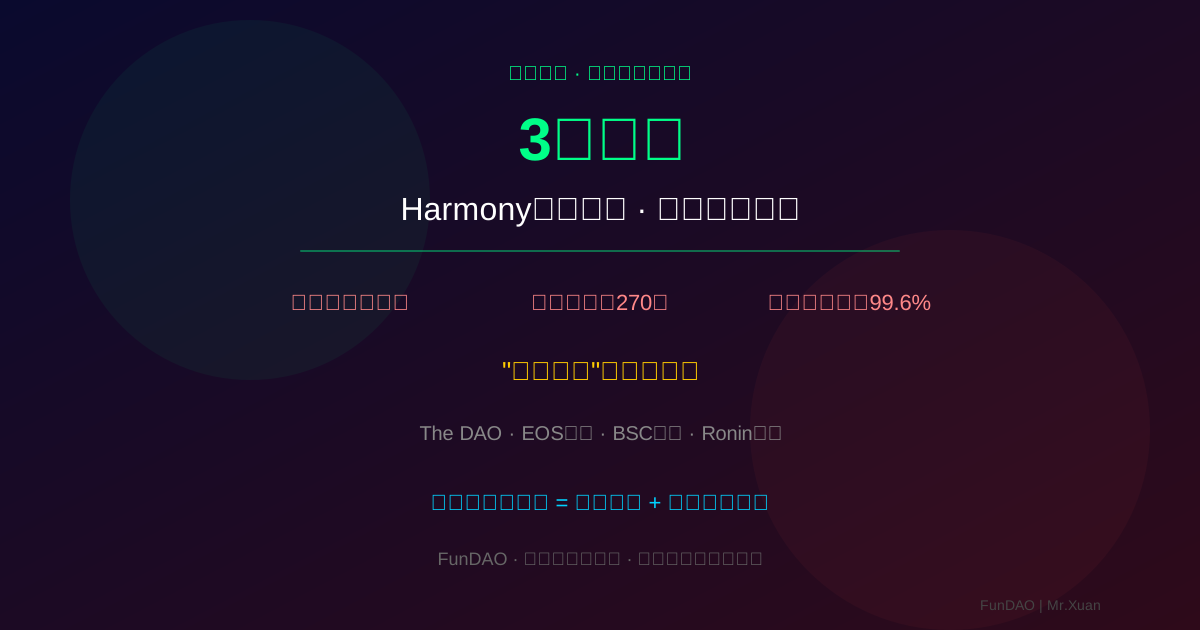
On August 13, something happened on the Harmony chain that deserves a place in crypto history: an attacker exploited a minting vulnerability to create over 3 trillion ONE tokens out of thin air.
Three trillion. Harmony's circulating supply was roughly 11 billion. This single exploit increased it by 270x. If you held ONE, your tokens were diluted by 99.6% in an instant.
But the really surreal part was what came next. The Harmony team quickly announced they would roll back the transactions, patch the vulnerability, and publish a list of attacker wallets.
Stop and think about that.
Rollback? Isn't That What Centralized Databases Do?
For the past decade, the word "blockchain" has been wrapped in an almost religious belief: immutability. What's written cannot be changed, deleted, or reversed.
But Harmony is now telling you: something went wrong, so we're rolling it back.
Consider the logic:
- Did the transaction succeed? Yes. Tokens were minted, on-chain.
- Then why roll back? Because the outcome is unacceptable.
- Who decides what's acceptable? The Harmony team.
How is this different from a bank spotting a suspicious transfer and manually reversing it?
This Isn't the First Time, and It Won't Be the Last
Veterans will remember The DAO incident in 2016. Ethereum faced the same choice: a hacker exploited a vulnerability and drained 3.6 million ETH. The community voted to hard fork and roll back.
The result? Ethereum split into ETH and ETC. Most people chose the chain that "could be altered."
Since then, we've seen EOS freeze accounts, BSC Chain halt block production, and Ronin bridge get hacked with officials issuing replacement tokens. Each time, the project says "these are special circumstances." But special circumstances happen so frequently that you have to ask: who's really custodizing your assets?
What "Immutable" Actually Means
Many people misunderstand immutability. It's not that nothing can go wrong on-chain. It means:
- Once deployed, rules cannot be changed — even by the creator. No admin backdoor, no emergency pause button.
- All operations are publicly transparent. Anyone can see where funds go.
- No "special circumstances" exceptions. Rules are rules, regardless of what happens.
Sounds idealistic, right? But that's exactly why some people choose DeFi over CEX — you don't need to trust anyone because no one has special privileges.
FunDAO's Choice: Throwing Away the Keys From Day One
When FunDAO deployed its contracts, it made a decision: permanently renounce minting authority and admin privileges.
This means:
- No one can mint more tokens — not because of a vulnerability, not because of "special circumstances"
- No one can pause trading — no matter how panicked the market gets
- No one can change the distribution rules — 60% deflationary burn, 25% liquidity, 15% team locked, written in code, forever
Harmony's incident teaches everyone a lesson: if a chain's creators can roll back, then "immutability" on that chain is a marketing slogan, not a technical fact.
True immutability doesn't come from team promises. It comes from renounced permissions. When even the creator can't change things, that's when it's truly unchangeable.
Three Tips for Regular People
- Check permissions: Does the token you hold have a mint function? Can the admin issue more? The code is public — spend 5 minutes looking.
- Check rollback history: If a chain has rolled back before, it can roll back again. "Immutable" isn't self-proclaimed; it's proven through action.
- Diversify risk: Don't put all your eggs on one chain. Cross-chain allocation, decentralized custody, permission-renounced projects — these are your safety net.
Harmony's story isn't over. Will the rollback succeed? Will the attacker's funds be recovered? We might have answers in a few days.
But there's one question that will never be answered: if the rollback succeeds, do you still believe those four words — "immutable"?
Author: Mr.Xuan | FunDAO Deep Analysis Series | This is not investment advice