From Bubble Coffee to AI Quant: 2026 Ponzi Schemes Put On Two New Disguises
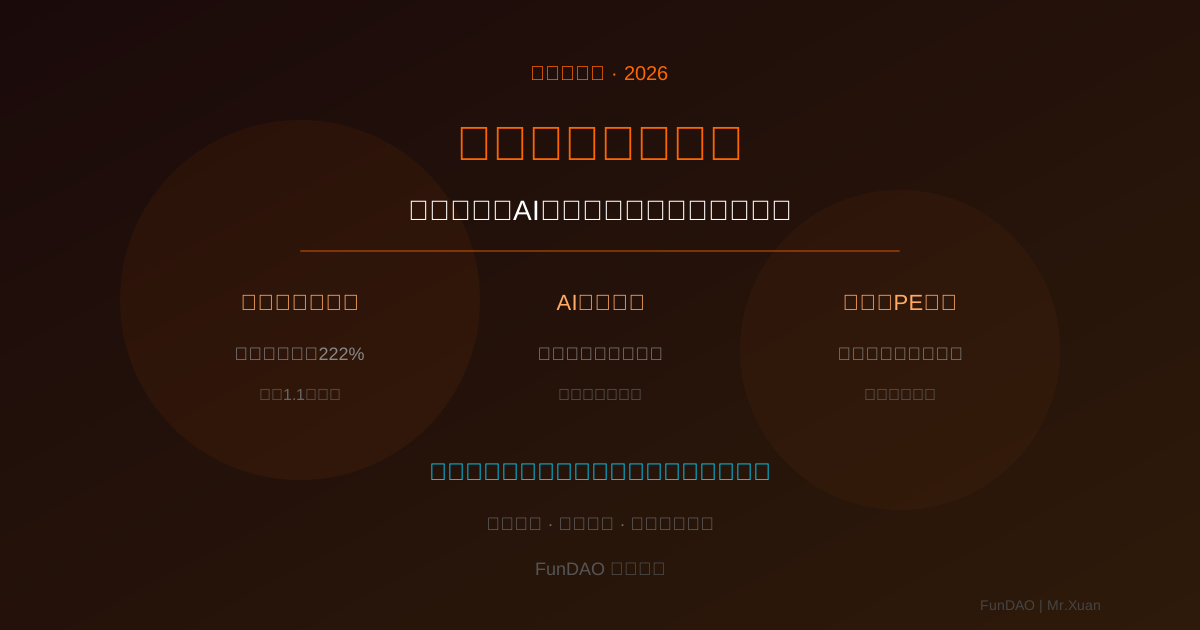
From Bubble Coffee to AI Quant: In 2026, Ponzi Schemes Put On Two New Disguises
Two recent scam cases are particularly interesting when examined together — they reveal the clear evolution trajectory of 2026-era fraud.
First: Fun Coffee (Bao Coffee). Hong Kong and Macau, involving HK$110 million, 8 people already arrested. The core packaging? A physical coffee shop. You walk into a beautifully decorated cafe on the street — real store, real coffee, real staff — and you think "how could this possibly be a scam?"
But it is. Annual returns of 222%. You "invest" $10,000 in a coffee shop, and they promise $22,200 in annual returns. Where does the money come from? From later investors' principal. Classic Ponzi structure, just wearing an "实体 business" disguise.
Second: Chunhua Venture Capital clone scam. This one is more cunning — it directly impersonated a real PE firm called "Chunhua Capital," using their name and logo to create a fake "Chunhua Venture" APP, promising daily returns of 1.8%. Many victims searched for "Chunhua Capital," found a real large investment firm with real offices and real news coverage — and trusted it.
But what they didn't know: the real Chunhua Capital never made a retail investment APP. That APP was built by scammers, the logo was photoshopped, the registration was fake.
Two cases, two different disguise strategies. Together, they show that Ponzi schemes are undergoing an "upgrade."
Three Generations of Ponzi Evolution
Generation 1: Crude and Direct (2015-2020)
Features: daily returns 1%-3%, referral bonuses 10%-30%, no real business, pure Ponzi. Examples: various "mutual aid platforms" and "split boards."
Difficulty to identify: Low. "Daily 2%, referral bonus 15%" — even aunties wouldn't fall for this today.
Generation 2: Concept Packaging (2020-2024)
Features: piggybacking on hot concepts. When blockchain was hot, they packaged as "blockchain wealth management." When metaverse was hot, "metaverse real estate." When AI was hot, "AI quantitative trading." Examples: various "AI smart mining" and "metaverse land investment" schemes.
Difficulty to identify: Medium. The concepts are real, but the business is fake. Ordinary people struggle to distinguish whether "AI quantitative trading" is real technology or fake packaging.
Generation 3: Physical + High-Tech Hybrid (2024-Present)
Features: no longer satisfied with pure online packaging, now combining physical stores + high-tech narratives. Bao Coffee uses a real cafe as trust endorsement. Chunhua Venture uses a real institution's brand for credibility嫁接. Combined with "AI algorithms," "big data risk control," "smart contracts" — making the scam appear to have both "physical foundation" and "technical sophistication."
Difficulty to identify: High. This is currently the hardest generation to spot.
Why Is Generation 3 So Hard to Identify?
Because its disguise precisely targets two trust anchors in ordinary people's minds:
Anchor 1: "Physical store = trustworthy"
This is human instinct — if they can afford rent, decoration, and staff, they must have "substance." But the reality is, opening a coffee shop might cost a few hundred thousand, while the funds absorbed are HK$110 million. Leveraging a few hundred thousand in costs to pull off a HK$110 million scam — the leverage ratio beats any financial instrument.
Anchor 2: "Name matches the real one = it's real"
Chunhua Venture impersonated Chunhua Capital. Ordinary people search "Chunhua Capital," see real news, real office photos, real executive information — trust instantly builds. But they don't realize that the "Chunhua Capital" they found and the "Chunhua Venture" scamming them are not the same company.
A one-character difference is the line between real and fake.
5 New Features of 2026 Ponzi Schemes
Based on recent cases, I've summarized the new characteristics of 2026-era scams. Compared to previous generations, the changes are clear:
1. From "high returns" to "reasonable-looking returns"
Old scams openly promised daily 2%, monthly 60%. New scams learned "restraint" — Bao Coffee's 222% annual looks high, but they break it into "18.5% monthly," which sounds less extreme. Chunhua Venture's daily 1.8% translates to 657% annual, but they never tell you the annual figure.
2. From "pure online" to "online + offline"
Physical stores, offline seminars, even "inspection tours" — taking you to "visit" their coffee shops, farms, factories. You see "business operations" with your own eyes, trust maxes out. But you don't know those "operations" are just props — the real profit source is only later investors' principal.
3. From "fake names" to "impersonating real brands"
Before, they'd invent a fancy-sounding name. Now they directly impersonate well-known real institutions — Chunhua Capital, Sequoia Capital, Goldman Sachs... change one character in the name, copy the logo, make the website look identical to the real one.
4. From "single narrative" to "multi-dimensional packaging"
Physical store + AI + blockchain + compliance license (fake) + celebrity endorsement (photoshopped) — multi-angle packaging simultaneously, making you feel "this project is solid" from every direction.
5. From "quick collapse" to "long-term operation"
Old scams collapsed in months. New scams learned "nurturing" — paying returns on time in early stages, building reputation, attracting more investors. How long did Bao Coffee operate? Long enough to absorb HK$110 million. The longer it runs, the more victims, the bigger the loss when it collapses.
How to Protect Yourself: Return to One Basic Principle
No matter how Ponzi schemes evolve, no matter how sophisticated the disguise, one principle always works:
Where do the returns come from?
Bao Coffee says "coffee shop profits" — but a coffee shop's annual profit is at most a few hundred thousand. How does that support 222% annual returns on HK$110 million in investment? Mathematically impossible.
Chunhua Venture says "AI quantitative trading returns" — but real quant funds make 15%-30% annually. How can they offer retail investors daily 1.8% (657% annual)? Mathematically impossible.
Goliath Ventures says "DEX liquidity pool returns" — but real DEX liquidity provision yields 5%-20% annually. How can they offer "guaranteed principal + monthly 3%-10%"? Mathematically impossible.
All Ponzi schemes ultimately die on mathematics. No matter how beautiful the packaging, if the return promise exceeds what the underlying business can genuinely produce, the difference can only be covered by later investors' principal — that's Ponzi.
FunDAO's Logic: No Packaging Needed
At this point you might ask: isn't FunDAO also making promises?
My answer: FunDAO doesn't need to make promises, because its mechanism doesn't require you to believe anyone's word.
FunDAO doesn't promise "guaranteed principal," doesn't promise "fixed returns," doesn't promise "monthly X%." Its mechanism is simple: every transaction — 60% goes to the liquidity pool, 25% is burned, 15% goes to ecosystem development. All data is publicly verifiable on BSCScan.
You don't need to trust FunDAO's team (permissions discarded), don't need to trust FunDAO's technical docs (code is open source), don't need to trust FunDAO's marketing (on-chain data doesn't lie). You just need to look at the contract and judge for yourself.
Bao Coffee needs you to believe its coffee shop profits. Chunhua Venture needs you to believe its AI quant capabilities. Goliath Ventures needs you to believe its DEX strategy.
FunDAO only needs you to believe math.
Math doesn't lie.
One Final Word
2026 Ponzi schemes are getting harder to identify. They have physical stores, high-tech narratives, impersonated real brands, and polished APPs.
But no matter how many disguises they wear, the core question remains: where do your returns come from?
If they can't answer, or the answer doesn't hold up mathematically — no matter how beautiful the store, how精致 the APP, how impressive the name — turn around and walk away.
By Mr.Xuan | FunDAO Research