SEC and CFTC Rarely Team Up: How Did the $400M Ponzi Scheme Goliath Ventures Fool 1,600 People?
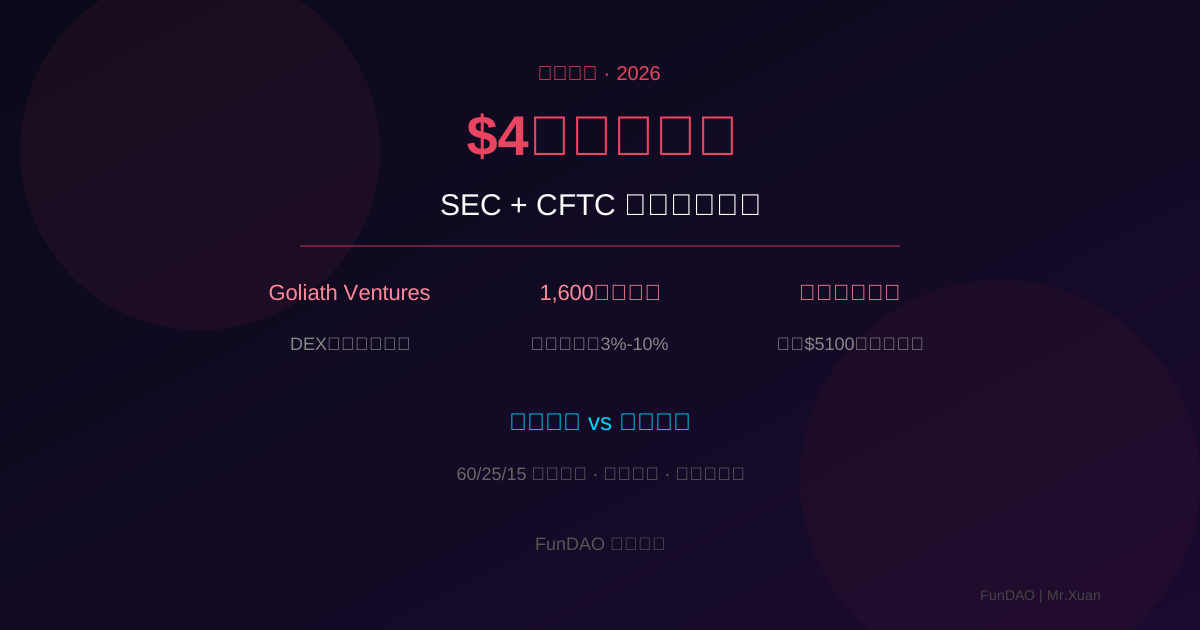
SEC and CFTC Rarely Team Up: How Did the $400M Ponzi Scheme Goliath Ventures Fool 1,600 People?
On August 12, something major happened in crypto: the US SEC (Securities and Exchange Commission) and CFTC (Commodity Futures Trading Commission) filed a joint lawsuit against Goliath Ventures on the same day.
You might think 'another lawsuit, what's the big deal?' But this time is different — SEC and CFTC joint action is extremely rare in crypto regulatory history. These two agencies normally operate separately — SEC handles securities, CFTC handles commodity futures. For them to drop departmental walls and act together means this case is so big that both agencies felt 'I have to be involved.'
$400 million involved, 1,300 to 1,600 victims, the founder has already pleaded guilty, sentencing on October 8.
But this article isn't about retelling the news — you can find that anywhere. What I want to discuss is: how did a Ponzi scheme disguised as a 'DEX liquidity pool' convince 1,600 supposedly smart people to hand over $400 million?
Let's Dissect Their Pitch First
Goliath Ventures marketed itself as a 'decentralized exchange liquidity pool project.' Sounds professional, right? DEX, liquidity pools, DeFi — all hot buzzwords in crypto.
But if you strip away the jargon, their core promise was one sentence: 'Principal guaranteed, monthly returns of 3% to 10%.'
Monthly returns of 3% to 10% means annual returns of 36% to 120%. And 'principal guaranteed.'
Think about that.
Warren Buffett's 20% annual return is already legendary. A crypto project telling you 'guaranteed principal + 36%-120% annual' — that's not investing, that's betting against your own mathematical common sense.
But 1,600 people believed it. Why?
Because Their Packaging Was Too 'Real-Looking'
Goliath Ventures wasn't some crude 'high-yield investment group chat.' It had a professional website, what looked like legitimate technical documentation, and even surface-level integrations with real DeFi protocols.
This is the scariest thing about 2026-era scams — they've learned to wear DeFi clothing.
What did old-school scams look like? 'Daily return 1.8%, refer friends for 10% bonus' — obviously a scam at first glance. But Goliath Ventures said 'DEX liquidity provision,' 'AMM strategy,' 'smart contract yield optimization' — every single term is a real DeFi concept, but combined together it's a complete lie.
It's like someone wearing a white coat with a stethoscope, speaking in medical terminology — you instinctively assume they're a doctor. But the white coat could be from Taobao, the stethoscope could be a prop.
A real doctor doesn't need a white coat to prove they're a doctor — their prescription license, credentials, and hospital affiliation are the proof.
A real DeFi project doesn't need the term 'liquidity pool' to prove it's DeFi — whether its contract code, capital flows, and distribution mechanisms are on-chain verifiable is the proof.
Where Did the Money Go?
The indictment revealed a detail that's almost absurd: the founder embezzled $51 million for personal luxury spending.
$51 million. Not $5.1 million, not $510,000 — $51 million.
Where did this money come from? From those 1,600 investors who believed in 'guaranteed monthly returns of 3%-10%.' They thought their money was 'generating yield in a liquidity pool.' In reality, it went straight into the founder's personal account — buying luxury cars, watches, and mansions.
This is the essence of a Ponzi scheme: using later investors' money to pay earlier investors' 'returns,' with the difference going into the scammer's pocket. As long as new money keeps flowing in, the game continues. Once new inflows can't keep up with 'return' payments, the whole thing collapses.
Goliath Ventures collapsed. $400 million from 1,600 people — mostly gone.
How Did 1,600 People Fall For It?
You might think 'were all 1,600 people idiots?' But if you dig deeper, you'll find crypto veterans among the victims.
Here's why:
First, the power of social proof. When you see someone in a group chat saying 'I've been getting returns for 3 months, 5% monthly, totally stable,' your guard drops significantly. Ponzi schemes do pay 'returns' on time in the early stages — because that money comes from later investors. These 'real deposit records' are the most persuasive tool.
Second, the迷惑性 of technical jargon. 'DEX liquidity pool,' 'AMM strategy,' 'yield optimization' — these terms are like a foreign language to non-technical investors. The scammer doesn't need you to actually understand; they just need you to think 'sounds professional.'
Third, FOMO (Fear of Missing Out). '5% monthly returns and you're not in? Others have been earning for 3 months already.' This hits a human weakness directly. You're not afraid of losing money — you're afraid others are making money and you're not.
How to Identify These Scams: 5 Red Flags
After studying the Goliath Ventures case, I've summarized 5 signals for identifying Ponzi schemes. Run any project through these 5 checks:
1. 'Guaranteed principal + high returns' appearing together — The fundamental law of finance is that returns and risk are proportional. Guaranteed principal means low risk; low risk cannot produce high returns. Both terms together = 100% scam.
2. Opaque capital flows — Which contract did your money go into? What's the contract address? Can you look it up on a blockchain explorer? If the project says 'our strategy is proprietary,' they're saying 'you can't verify.'
3. Unclear return sources — 'DEX liquidity pool returns' sounds professional, but ask 'where exactly do returns come from? Trading fees? Arbitrage?' If they can't answer or deflect with more jargon, that's a red flag.
4. Withdrawal barriers or delays — 'T+7 settlement,' 'requires review,' 'large withdrawals need advance notice' — these are classic Ponzi features. In real DeFi protocols, your money is in the contract, withdrawable anytime.
5. Referral bonuses — No matter how sophisticated the packaging, if the core growth logic is 'refer friends and get rewards,' it's a Ponzi structure.
FunDAO's Approach: You Don't Need to Trust Me
At this point, you might think 'so FunDAO isn't a Ponzi? How do you prove it?'
Good question. My answer: you don't need to trust me, you need to trust on-chain data.
FunDAO's distribution mechanism is 60/25/15 — every transaction's capital flow is written into the smart contract, verifiable by anyone on BSCScan. Who gets 60%, who gets 25%, who gets 15% — it's all transparent.
No 'proprietary strategy,' no 'undisclosed methods,' no 'your money is safe with us, please trust us.' The code is the proof, on-chain is the truth.
Goliath Ventures' 1,600 victims — if they had checked capital flows upfront, they might not have been scammed. But the problem is — they couldn't check. Because Goliath's capital flows were a black box.
FunDAO's capital flows are a glass box. You can see, I can see, everyone can see.
One Honest Truth to Close
The SEC and CFTC joint lawsuit is good news — it shows regulators are acting. But regulation is reactive — Goliath Ventures' $400 million is already gone, and most of those 1,600 people's money isn't coming back.
Regulators can catch scammers, but they can't protect you from scammers. Scam prevention ultimately depends on you.
Next time someone tells you 'guaranteed 5% monthly returns,' ask one question first: which contract did the money go into? Show me the contract address.
If they can't provide a contract address, or provide one but you can't trace the capital flows — turn around and walk away. Don't look back.
By Mr.Xuan | FunDAO Research