Tether Passes KPMG Audit, But Why Is the Market More Skeptical? The Difference Between 'Audit Passed' and 'True Transparency'
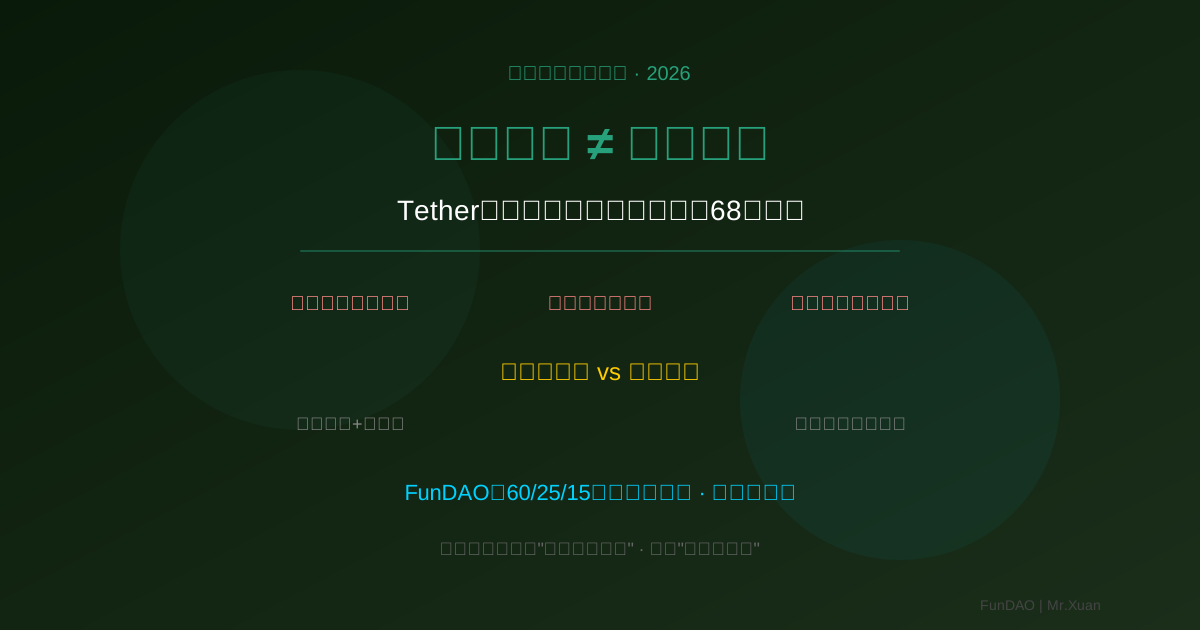
Tether passed its audit.
KPMG's report shows Tether's reserve assets exceed liabilities by $6.8 billion. On paper, that's good news — USDT's ability to redeem is backed.
But the market's reaction is telling. After the report came out, skepticism didn't decrease — it increased.
Why?
"Audit Passed" Doesn't Equal "Transparent"
First, let's look at what the audit didn't cover.
KPMG's scope was Tether's reserve assets — meaning, Tether claims to have this much money somewhere, and the auditor confirmed "yes, it exists."
But the audit didn't cover:
- Private loans — Tether was previously exposed for lending reserve funds to affiliated companies
- Derivatives trading — Tether's involvement in complex financial products
- Asset quality — How much of reserves is cash, how much is commercial paper, how much is other low-liquidity assets?
- Real-time nature — The audit is a snapshot at one point in time, not real-time monitoring
Simply put: the auditor confirmed "money exists" but didn't confirm "quality of the money" or "whether the money is always there."
It's like buying a used car. The seller says "the car runs." You hire an inspector who confirms "yes, it runs." But the inspector didn't check if the engine was rebuilt, if the frame was welded, or if the odometer was rolled back.
"Runs" and "safe and reliable" are worlds apart.
Tether's Transparency Debate: Why Has It Lasted So Long?
Tether's transparency issue isn't new. Since USDT's birth, the质疑 hasn't stopped.
In 2019, the NY Attorney General discovered Tether had used $8.5 billion in reserve funds to "temporarily" cover Bitfinex's losses. In other words, a large portion of USDT's reserves were "IOUs," not real assets.
Tether later said it was repaid. But this incident made many people realize: Tether's reserves aren't that transparent.
Every time an audit report comes out since then, the market rehashes this issue. Then reaches the same conclusion: audit doesn't equal transparency.
The Essential Difference Between "Third-Party Audit" and "On-Chain Transparency"
There are two completely different transparency models here:
Model A: Third-Party Audit (Tether model)
- Company claims how much reserves it has
- Hires auditor to check
- Auditor issues report confirming "basically accurate"
- You need to trust the company, trust the auditor, trust the report's scope and timing
Model B: On-Chain Transparency (FunDAO model)
- All rules written in smart contract, code is open source
- Every fund flow is verifiable on-chain
- Distribution ratios (60/25/15) executed automatically by contract, no one can interfere
- You don't need to trust anyone — you just check the chain yourself
Model A's problem: you're always "trusting someone." Trust the company, trust the auditor, trust the regulator. If any link fails, your "transparency" is an illusion.
Model B's logic: no trust needed. The code is there, the data is on-chain, anyone can verify. Not "someone tells you it's transparent" but "you can verify it's transparent yourself."
Why Is USDT Still Alive?
If transparency has so many issues, why is USDT still crypto's largest stablecoin?
Three reasons:
- Network effect — Every exchange pair supports USDT, every DeFi protocol prices in USDT. Switching cost too high.
- "Too big to fail" — USDT market cap exceeds $100 billion. If Tether collapses, the entire crypto market gets hit massively. So everyone "plays along."
- Lack of true alternatives — USDC is more transparent but market share far smaller than USDT. DAI is decentralized but its collateral includes USDT.
Simply: USDT's position isn't because it's "the best" but because it's "the first," "the biggest," "the hardest to replace."
Lessons for Regular Users
- Don't equate "audit passed" with "completely safe" — Audit is just a snapshot, not a real-time guarantee
- Focus on reserve "quality" not just "quantity" — $10B in commercial paper and $10B in cash are completely different things
- Prefer projects verifiable on-chain — Not "someone says it's safe" but "you can verify it's safe yourself"
FunDAO Perspective: Transparency Without Audit Reports
FunDAO has never issued an "audit report." Because it doesn't need to.
All data is on-chain. Want to know FunDAO's reserves? Check the chain. Want to verify the 60/25/15 distribution is being executed? Check the chain. Want to know if anyone is secretly minting tokens? Check the chain.
No need to wait for KPMG reports, no need to wait for quarterly disclosures, no need to trust any intermediary.
True transparency isn't "publishing a report every quarter" but "verifiable every second."
Author: Mr.Xuan | FunDAO Deep Analysis Series | This is not investment advice