TRUMP Team Dumps at $2.68 Average — The 'ATM' Nature of Political Meme Coins
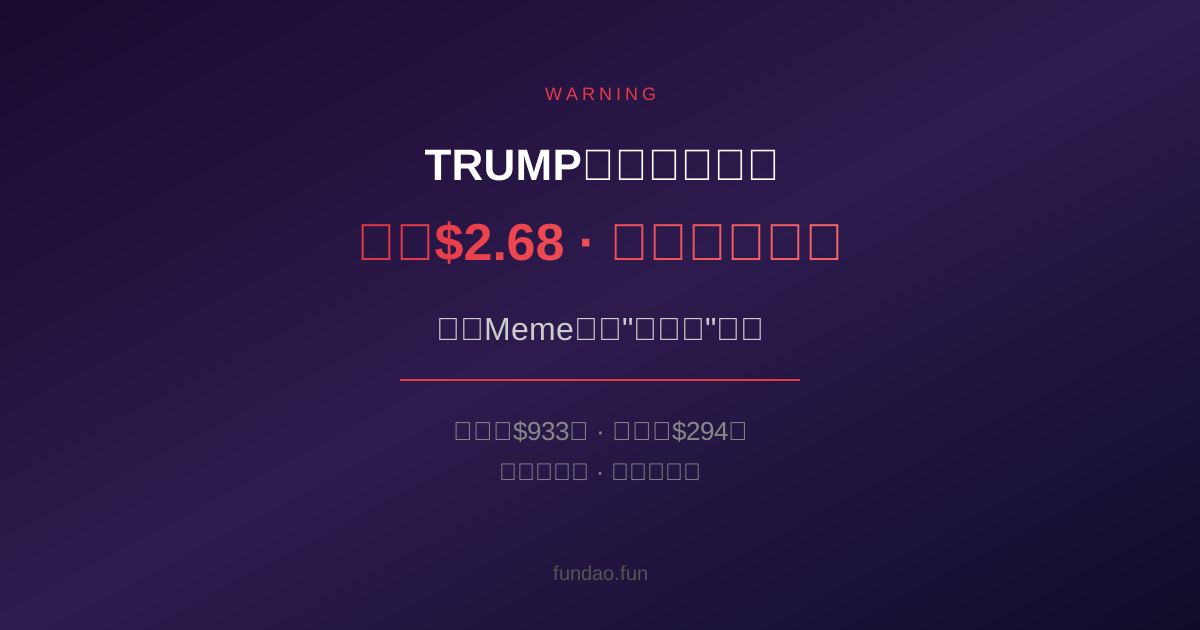
The TRUMP team sold again.
On August 23, on-chain data shows the TRUMP team address transferred out and dumped a large amount of tokens — the second consecutive day of selling. Yesterday it was $9.33 million, today another $2.94 million. Average price: $2.68.
In other words, the issuer is "clearing out" — dumping everything.
Meanwhile, retail holders are still holding on, still waiting for "the president to come back and save the market."
This is the truth about political meme coins — you think you're supporting a president, but you're actually providing exit liquidity for someone else's cash-out.
Political Narrative → Emotional Pump → Insider Cash-Out
TRUMP's playbook is identical to every meme coin, just with an extra "political filter."
Step 1: Create the narrative. Trump is the most talked-about person on Earth. Every speech, every controversy, every social media post generates massive traffic. When "president launches a coin" becomes news, everyone takes a look.
Step 2: Emotional pump. Retail psychology is "if the president's coin goes up, that's politically correct." This sentiment drives疯狂 buying in the short term. No fundamentals needed, no product, no revenue — just the three letters "T-R-U-M-P."
Step 3: Insider cash-out. When the price is pushed high enough by emotion, team addresses start selling. Not all at once — gradually, day by day, so retail thinks "it's just a normal pullback."
On-chain data doesn't lie. The TRUMP team address holdings have been declining consistently over the past week, while retail holder concentration is increasing. In plain English: smart money is running, retail is catching the bag.
The "Fatal Flaw" of Political Meme Coins
All meme coins share a common problem: no intrinsic value. But political meme coins have an additional fatal flaw — they depend on one person.
Bitcoin doesn't need Satoshi. Ethereum doesn't need Vitalik. But TRUMP coin needs Trump.
What Trump says, the coin follows. Trump posts on social media, the coin swings 10%. Trump attends a crypto conference, the coin pumps 20%.
What does this mean? The coin's "lifeline" isn't on-chain, isn't in the code, isn't in the community — it's in one person's emotions and decisions.
And that person just told you with on-chain data: he's selling.
"With Project Team" vs "No Project Team"
Many people think "having a team" is good — someone building, someone promoting, someone "responsible."
But the TRUMP coin case proves: having a team = having someone who can manipulate you.
The team decides when to mint, how much, who to sell to, when to cash out. As a retail holder, you have zero say in any of these decisions. Your only option is to "guess" — guess what the team will do next.
This isn't investing. This is gambling. And your opponent can see your cards.
In the crypto world, there's a completely different design philosophy: no project team.
No team addresses, no pre-mine, no "insiders." The moment the contract is deployed, the rules are locked. No one can mint more tokens, no one can change distribution ratios, no one can "run away" — because there's nowhere to run to.
FunDAO follows this philosophy. Its contract permissions have been renounced, meaning no one — including the original developers — can change the rules. 60% goes to the liquidity pool, 25% to sharing rewards, 15% weekly dividends, 2.5% daily deflationary burn. These numbers are written on-chain, verifiable by anyone, immutable by everyone.
You don't need to "trust" anyone because the rules themselves are transparent.
How to Identify "ATM" Projects
Not all meme coins are scams, but most political meme coins are designed as "attention monetization" from the start. The identification method is simple:
1. Check team holding concentration. If the top 10 addresses hold more than 50% of supply, it's an "insider game."
2. Watch team address activity. If team addresses are continuously transferring tokens to exchanges, they're preparing to sell. On-chain data is public — anyone can check.
3. Compare "narrative" vs "product" ratio. If 90% of discussions are about "a person" rather than "a product," its value is built on that person. People leave; products don't.
4. Check for "exit mechanisms." If the team can modify rules, mint tokens, or adjust distributions at any time — you're "allowed" to participate, not an equal participant.
Conclusion
The TRUMP team clearing out at an average price of $2.68 isn't "insider information" — it's public on-chain data. Anyone could see it; most people just chose not to.
The "ATM" nature of political meme coins isn't complicated: use political narrative to attract attention, use emotion to pump the price, use insider cash-out to complete the harvest. Three steps done, and the retail's coins become "souvenirs."
Next time you see a "president coin," "celebrity coin," or "influencer coin," ask one question first: Is the issuer buying or selling?
On-chain data will give you the answer.
Disclaimer: This article is for informational and educational purposes only and does not constitute investment advice. Cryptocurrency investment carries high risk. Please do your own research and make cautious decisions.