Pump.fun Makes $34.68M Monthly: The Meme Coin "Shovel Sellers" Are Getting Rich While 99% of Players Lose Money
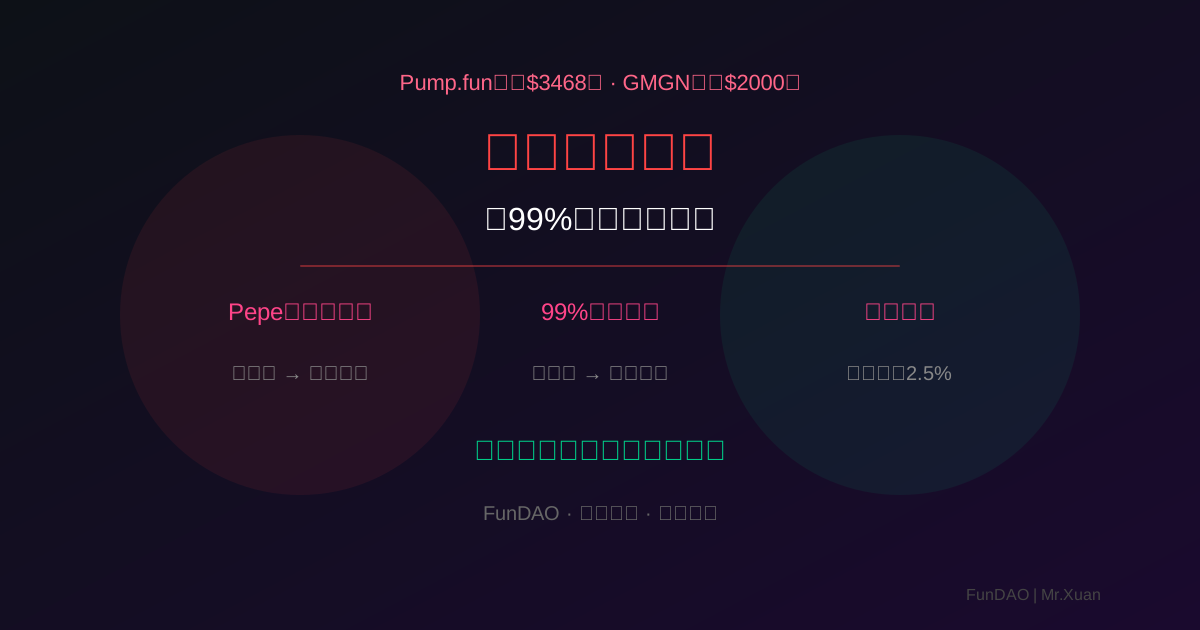
Pump.fun Makes $34.68M Monthly: The Meme Coin "Shovel Sellers" Are Getting Rich While 99% of Players Lose Money
There's a set of numbers making rounds in crypto lately: Pump.fun's July revenue hit $34.68 million, and GMGN (another Meme trading platform) pulled in close to $20 million for the month.
Two platforms combined, extracting over $50 million from Meme coin players' pockets in a single month.
$50 million. Put that in perspective: that's $1.7 million drained from retail investors every single day, like clockwork.
But here's the strange part — the platforms are printing money, Meme coin creators occasionally strike it rich, but what about the vast majority of regular players? They're losing so badly they can't even recognize their own losses.
That's the core question of this article: in the Meme coin ecosystem, who's actually making money? Who's losing? And — is there a model where ordinary holders, not platform owners, become the real beneficiaries?
First, Understand Pump.fun's Business Model
Pump.fun's business logic is brutally simple:
Anyone can create a Meme coin on Pump.fun for a few dollars → Others buy in → Pump.fun takes 1% from every transaction → The coin goes to zero → Next cycle begins.
Key observations:
First, creation cost is negligible. A few dollars to mint a token means thousands of new Meme coins are created daily. Supply is infinite, but buyers' money is finite.
Second, platform fees are guaranteed. Whether the coin pumps or dumps, whether you profit or lose, as long as a trade happens, Pump.fun takes its 1%. It doesn't care about coin value — only trading volume.
Third, going to zero is the norm. Statistics show over 99% of tokens created on Pump.fun eventually go to zero. Out of 100 coins launched, 99 become worthless paper.
This is the classic 'sell shovels during a gold rush' model. In the 1849 California Gold Rush, the people who made real money weren't the gold miners — they were the ones selling shovels, jeans, and water. Pump.fun is crypto's Levi's jeans — it profits regardless of whether miners live or die.
GMGN's Numbers Tell the Same Story
GMGN's $20M monthly revenue comes from a slightly different angle — it focuses on 'smart money tracking,' helping users find Meme coins that whales have already positioned in.
But the essence is identical: it earns trading fees, not price appreciation.
Think of these platforms as crypto casinos. The casino doesn't care if you win or lose — it only cares if you place bets. You bet, it takes its cut. The more you bet, the more it earns.
And retail investors? They're the gamblers. And what's the mathematical outcome for gamblers? The house always wins in the long run. Because every hand has a rake, the long-term expected value is negative.
What About Meme Coin Creators? Did They Make Money?
A small minority did make serious money. PEPE's early creator, for instance. Or certain Meme coin founders who went viral overnight.
But what are these people? Survivorship bias.
You see the one person who made $10 million. You don't see the 9,999 creators behind them whose coins went unnoticed and went to zero. And many 'successful' Meme coin creators have been exposed running insider schemes — pre-positioning themselves, then dumping on retail investors who bought in.
This week's news: Pepe's original creator zeroed out three contract addresses in one week, then blamed it on 'account hacking.' Do you buy that? Because I don't.
So Where's the Real Problem?
The problem isn't Meme coins themselves. As a cultural phenomenon, Meme coins have value — like lottery tickets. Everyone knows the odds are terrible, but people still happily spend $2 on a dream.
The problem is the ecosystem's distribution mechanism.
In Pump.fun's ecosystem, value flows like this:
Retail money → Platform fees (1%) + Early buyers profit + Creator insider trading → Retail losses
This is a zero-sum or even negative-sum game. Because the platform extracts 1%, all participants combined are guaranteed to lose. Someone's profit must come from someone else's loss — plus the platform's cut on top.
Is There an Alternative Model?
Yes. And the logic is completely inverted.
Instead of 'you trade, I take a cut,' it's 'you hold, you appreciate.'
FunDAO's deflationary model works on this principle: automatically burning 2.5% of circulating supply daily. No trading required, no platform fees. You buy and hold, and your ownership percentage increases every day — because total supply is decreasing.
Compare the capital flows:
Pump.fun model: Your money → Platform's pocket (guaranteed outflow) → Few profit → You lose
Deflationary model: Your money → Your holdings (no outflow) → Supply decreases → Your share increases
One model takes money from you every time you act. The other makes you appreciate automatically while you do nothing.
I'm Not Saying Don't Play Meme Coins
If you treat it like a lottery ticket — spending pocket money for fun — that's perfectly fine. Like buying a $2 scratch card: if you win, great; if not, no big deal.
But if you're treating Meme coins as an investment — 'this coin will 100x' — you're probably lying to yourself.
99% of Meme coins going to zero isn't a probability issue — it's a mathematical certainty. Infinite supply + limited demand + platform rake = the vast majority must lose.
Real investing should let you sleep at night, not refresh prices every 5 minutes.
One Uncomfortable Truth to Close
Pump.fun and GMGN making $50M monthly — where does that money come from? From pockets just like yours.
Next time you're about to ape into a Meme coin, ask yourself: Am I the one selling shovels, or the one buying them?
By Mr.Xuan | FunDAO Research